CareCompass
In design. A searchable database of skilled nursing facilities paired with a guided admission-paperwork intake for families — aimed at finding the right facility and completing the packet in under thirty minutes rather than three hours.
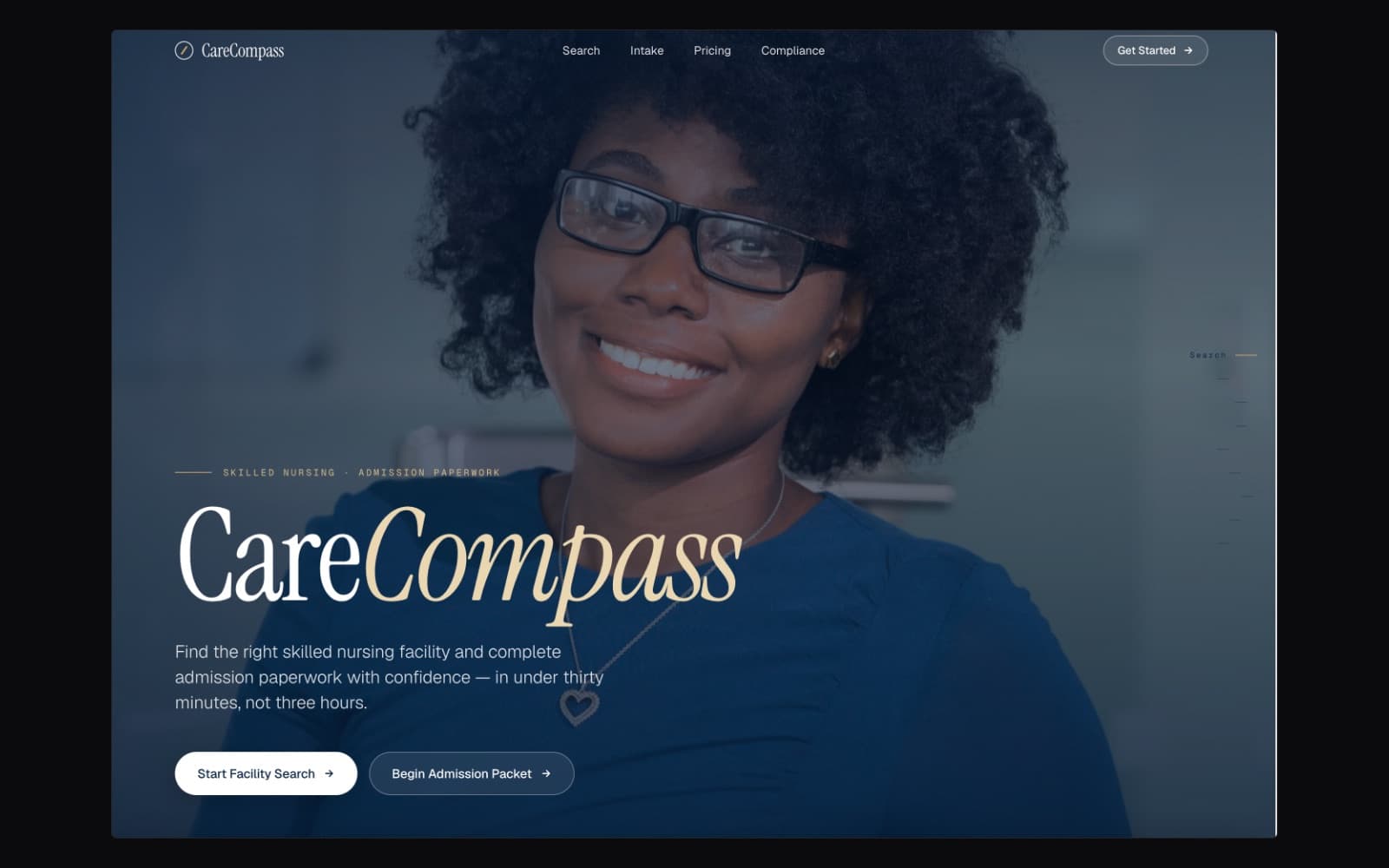
Overview
CareCompass is currently a design, not a product — the interface is drawn, the flows are worked out, and nothing has been built yet. The problem it addresses is one I watch families run into constantly. Choosing a skilled nursing facility usually happens under time pressure, often straight after a hospitalisation, and almost always without any prior experience of the system. Families face two separate problems at once: working out which facilities are appropriate and available, and then completing an admission packet that assumes knowledge they do not have. The design puts both in one place.
The problem
- Facility selection happens under time pressure, frequently during a discharge window measured in days.
- Families have no basis for comparison — the information that distinguishes one facility from another is scattered, inconsistent, or written for regulators rather than relatives.
- Admission packets assume familiarity with terminology, insurance mechanics and documentation that most families encounter for the first time.
- The paperwork burden lands on the person least equipped to carry it, at the worst possible moment.
Proposed approach
- A searchable facility database built around what a family actually needs to compare, not what is easiest to publish.
- A guided intake that takes the admission packet one step at a time and explains what each part is for.
- Plain language throughout — the interface assumes no prior exposure to skilled nursing.
- A compliance view, so the facility side of the process is served by the same tool rather than a parallel one.
Process
Start from the family's week
Map what actually happens between a discharge decision and an admission, and where the hours go.
Separate the two problems
Facility search and paperwork completion are distinct tasks with distinct failure modes; treat them as such rather than merging them into one funnel.
Write for the reader who has never done this
Every label and explanation is aimed at a relative under stress, not at an administrator who already knows the vocabulary.
What this has clarified
- The paperwork is not incidental to the admission — for the family it often is the admission.
- Two audiences share one process: what reduces work for the facility and what reduces confusion for the family are not automatically the same thing.
- Designing the search first and the intake second was the wrong order. The paperwork is where families actually lose their week, so it should lead.
Next steps
- Put the designed flows in front of families who have recently been through an admission, before any of it is built.
- Work out where the facility data would come from, and what could be kept current honestly.
- Scope a build once the intake flow survives contact with real families.
Related projects
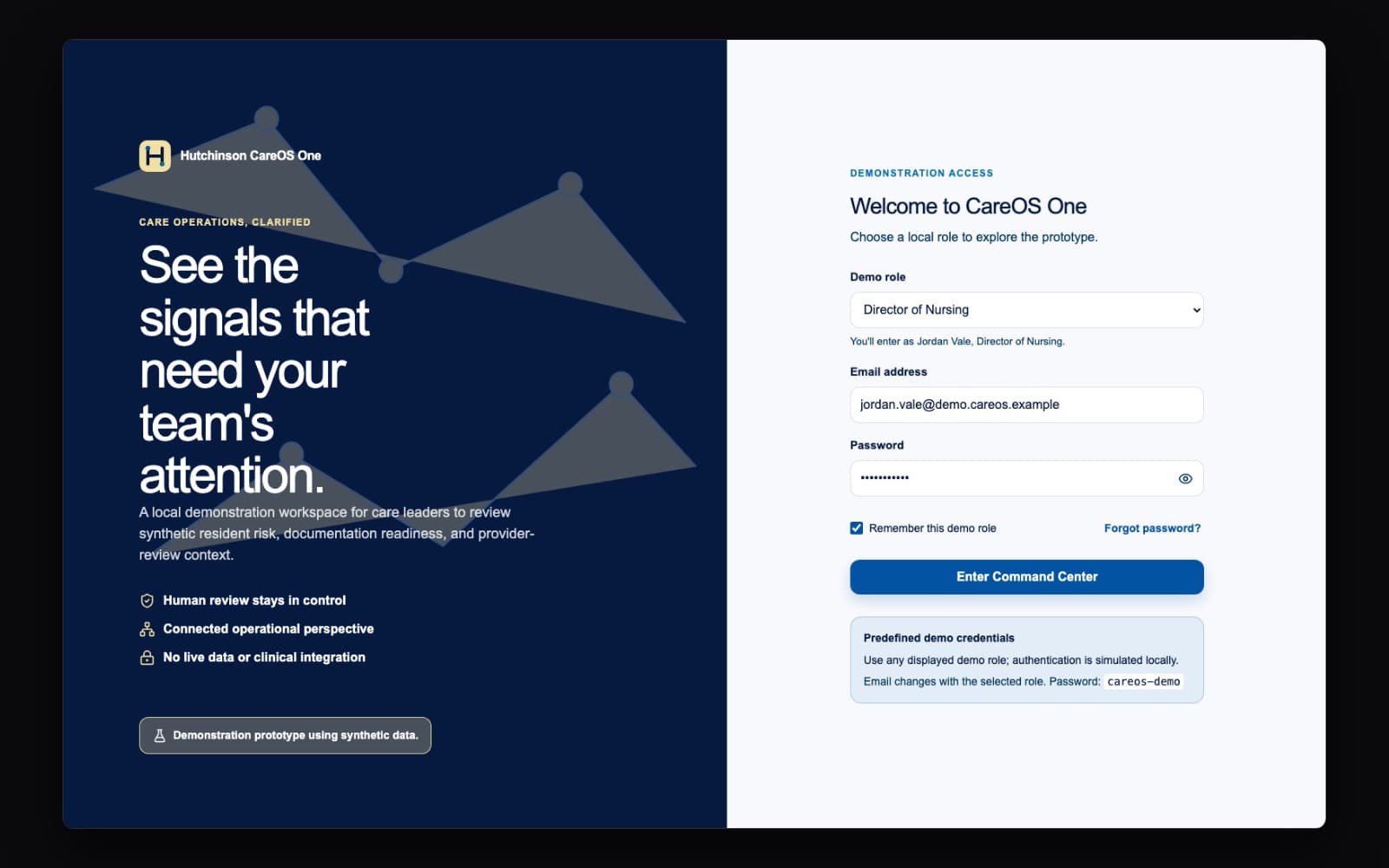
Hutchinson CareOS One
Care Operations, Clarified — a working prototype that gives skilled nursing leaders a connected operational view of resident risk, documentation readiness, and provider-review context, built entirely on synthetic data.

SNF AI Documentation System
A structured concept for improving skilled nursing documentation, clinical organization, consistency, and provider oversight with AI-assisted workflows.