Documentation systems
Structuring and cross-checking what a clinician has already recorded — organising entries, flagging omissions and contradictions at the point of care, and leaving the clinical narrative to the clinician.
Healthcare AI
The most valuable healthcare technology is not the technology that appears most advanced. It is the technology that reduces friction, supports better decisions, protects patients, and allows professionals to focus more attention on care.
“AI systems should support professional judgment, not replace licensed clinical decision-making.”
Why listen to me
I am a board-certified nurse practitioner carrying a daily census of 20–25 medically fragile patients across skilled nursing and long-term care facilities. Before that: twenty-seven years in emergency medical services, emergency and critical care nursing, and a pandemic spent on the front line of an academic medical center. The observations on this page are not gathered from research about healthcare workflows. They are what the work looks like from where I stand in it.
What I have observed
These patterns show up repeatedly in skilled nursing environments. They are observations from working inside them, not findings from a study.
Recording care competes directly with delivering it, and the competition intensifies as staffing tightens.
The same information is entered more than once because the tools holding it were never designed to interoperate.
Gaps are frequently discovered during review, audit, or survey — long after the moment when correcting them would have been simple.
Education designed around uninterrupted sessions rarely reaches staff working a full clinical schedule.
Where AI helps
Each of these reduces a real cost. None of them requires a clinician to trust the system beyond what it has demonstrated.
Structuring and cross-checking what a clinician has already recorded — organising entries, flagging omissions and contradictions at the point of care, and leaving the clinical narrative to the clinician.
Continuous, low-friction visibility into the records that quality and regulatory review depend on, so that preparation is a routine state rather than an event.
Short, specific, role-relevant education on using AI tools responsibly — including how to verify output and what must never be entered into a general-purpose system.
Rethinking how operational and quality information moves through a facility, rather than layering software onto processes that were never designed for it.
Ethical safeguards
These are design constraints, applied before anything gets built — not compliance work bolted on afterwards.
This website is a professional portfolio. It does not provide medical advice, diagnosis, or treatment, and nothing on it establishes a clinical relationship.
Related work
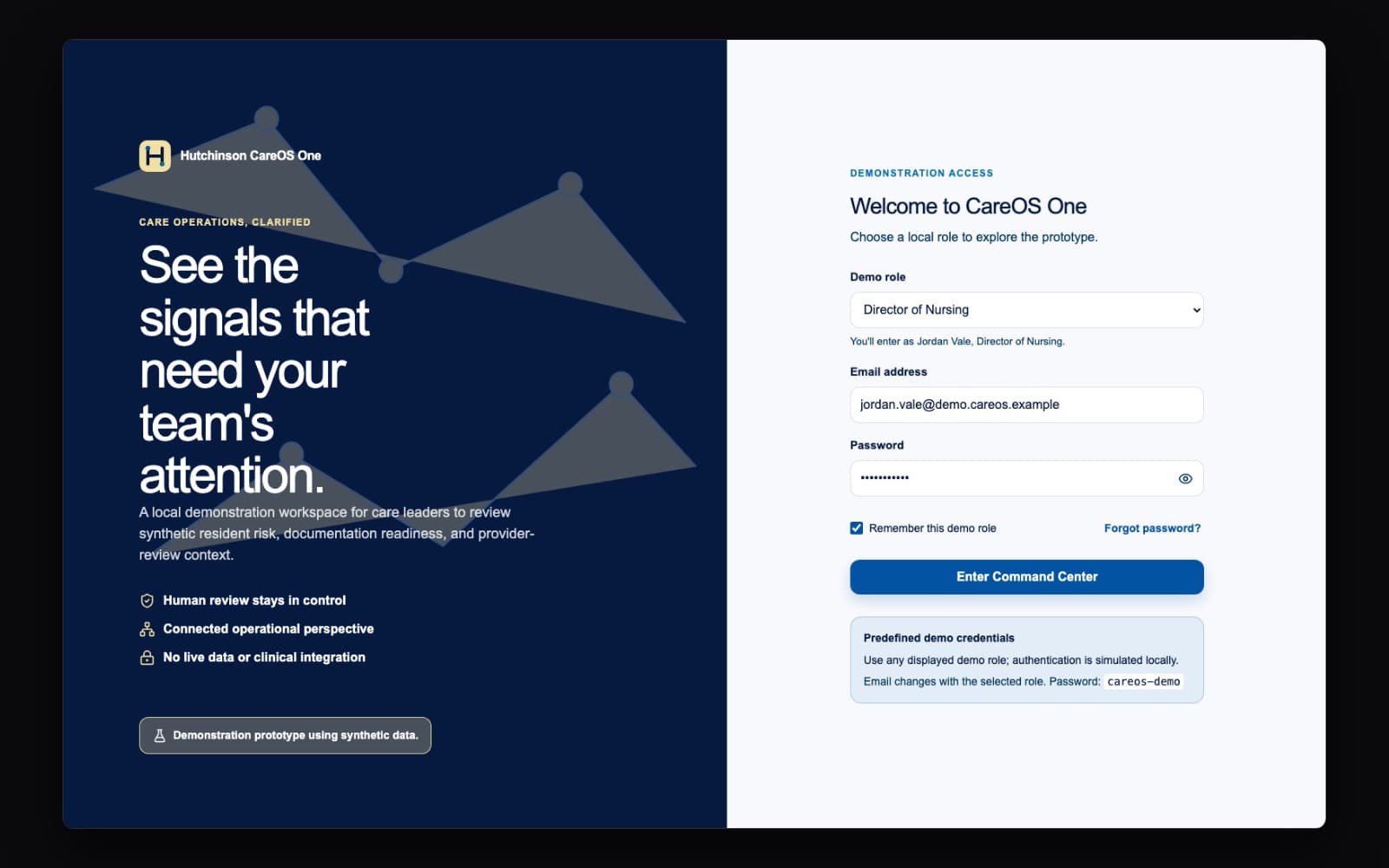
Care Operations, Clarified — a working prototype that gives skilled nursing leaders a connected operational view of resident risk, documentation readiness, and provider-review context, built entirely on synthetic data.

A structured concept for improving skilled nursing documentation, clinical organization, consistency, and provider oversight with AI-assisted workflows.

A future-facing operating model exploring how AI could streamline skilled nursing operations, improve quality monitoring, and reduce administrative friction.
Further reading
Most conversations about AI in long-term care start with the technology. A more useful starting point is the parts of the day that consume time without improving care.
Clinical staff are already using these tools. The open question is whether they are using them with any framework for judging when the output can be trusted.
Healthcare AI
If you work in skilled nursing or long-term care and any of this sounds familiar, I would genuinely like to hear how it looks from where you sit.